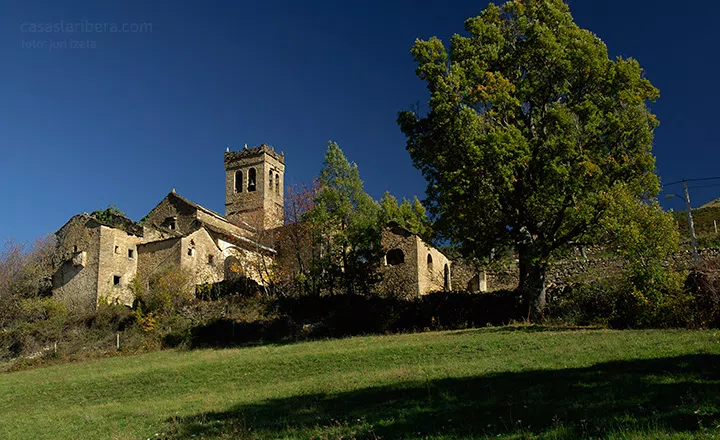
Valle del Ara
Km 0
L'Ainsa. Beautiful medieval old town (see route “From Barbastro to Aínsa”)
Km 7
Boltaña (all types of services). In Roman times it was the “municipium Boletanum”. It has a modern neighborhood next to the road and another old one lying on the San Martín tozal. Beautiful corners are preserved in this area. Almost all of its houses are whitewashed, something atypical in this region. At the top of the tozal stands a castle from the 11th century. The church preserves remains from the 13th century, but it was built in the 16th century. Inside there is an outstanding choir stall from the 16th-17th century, which comes from the San Victorián monastery.
Km 14-15
Jánovas Gorge. It is advisable to make a stop in this area to contemplate the beautiful folds of this strait. These are hard limestone strata arranged almost vertically that stand out among the loamy ones.
Km 15.5
Jánovas and its reservoir. After a small descent, a detour takes us to the town of Jánovas, uninhabited since the 1950s (like Lavelilla and Lacort located a little further on) due to the construction project of a reservoir that was never carried out. The project was discarded due to its strong environmental and socio-economic impact, the former inhabitants are now fighting for the reversion of their properties.
Km 15.5-19
La Solana de Burgasé. From this area several dirt tracks start on the right that lead to the 14 uninhabited towns of the La Solana valley and the only inhabited house: San Martín. They were shepherd villages and the entire valley was purchased and repopulated by ICONA to prevent the filling of the Jánovas reservoir, which was never built. Today, barely any vestige of that life and those buildings remains. The towns of Burgasé, Sasé, Cájol, Castellar and some others stand out.
Km 22
To our right is a pretty town: Jabierre de Ara. A few meters further on there is a detour towards another notable corner: Liguerre de Ara, with beautiful buildings (such as the Ballarín house) and a 17th century church.
Km 26.5
Tax (camping, various services). We will point out a church from the 16th century, as well as its tower with defensive functions. A tower from that same century also stands out.
Km 31.6
A detour to the right takes us in less than 2 km to Asín de Broto, a beautiful town as a whole, among which it is worth highlighting the 16th century church and its tower, the former 16th century conspiracy that stands next to the church, and some other building - like a house located to the south.
Km 40.7
Broto (gas station, hospitality, camping 1 km away). Taking the detour that leads to Oto, we can walk in 5 minutes from Broto to the foot of the beautiful Sorrosal waterfall. Oto is only 1 km away and is a beautiful town with a robust 15th century tower and its church. and Romanesque tower, although modified in later centuries. The second has very atypical windows that relate it to the art of the Serrablo churches, commonly called "Mozarabic."
Km 43
Towards the left the road continues towards Jaca. About 6 km away stands Linás de Broto and its temple with a defensive tower from the 16th century, among beautiful landscapes where the Tendeñera summit stands out. The surroundings of Linás, Viú and Fragen have a beautiful set of meadows and cabins. Continuing along the right branch we find:
km 44.5
Torla (all kinds of services, campsites). Beautiful view towards the entrance to the Ordesa valley, starring the large Mondarruego cliffs. Beautiful tourist center with a 16th century church with three naves and an octagonal dome. Some emblazoned houses (such as Casa Viú) and also the beautiful façade of its town hall (located in a square) deserve to be highlighted.
Km 47.3
Los Navarros Bridge. To the left a dirt track leads to Bujaruelo. The road on the right ascends to the Ordesa valley, but except out of season, private vehicles cannot be used and must be ascended with the bus that leaves from Torla, or on foot along the signposted Turietos path (1 h 45' from Los Navarros or 2 h 45' from Torla).
Texts: Joaquín Guerrero.
Any reproduction is prohibited without written permission from the company for the purposes of article 32.1, second paragraph, of the Intellectual Property Law.
EDIT